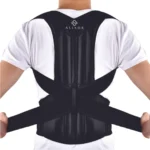
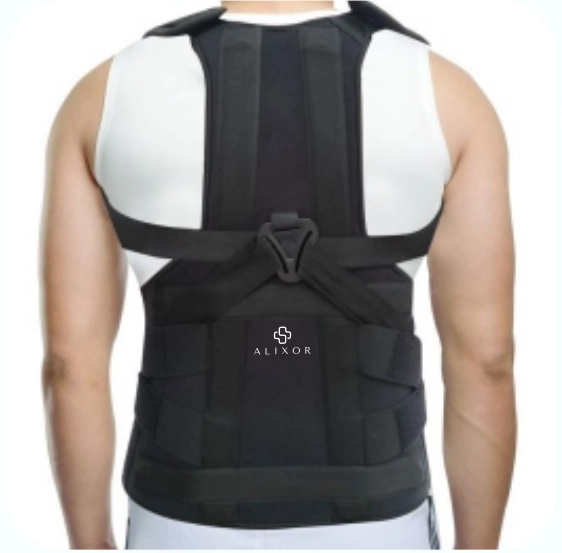
Taylor’s Brace, named after the American surgeon Charles Fayette Taylor who developed it in the 19th century, is a classic thoracolumbar spinal orthosis (TLSO) designed to limit flexion of the thoracic and upper lumbar spine while encouraging extension and improving upright posture.
The Alixor Taylor’s Brace is a modern interpretation of this time-tested design, manufactured with updated materials and precision engineering while retaining the biomechanical principles that have made it clinically relevant for over a century.
The brace consists of two posterior metal or rigid polymer uprights running parallel to the thoracic and lumbar spine, connected by an interscapular cross-band at the level of the upper thoracic spine and pelvic bands at the iliac crests.
Anteriorly, axillary crutches extend into the axillae to create a three-point force system that unloads spinal compression, encourages spinal extension, and reduces kyphotic angulation.
The primary clinical indication for the Taylor’s Brace is the management of thoracic and thoracolumbar compression fractures (including osteoporotic vertebral fractures), thoracic kyphosis secondary to Scheuermann’s disease or ankylosing spondylitis, post-laminectomy and post-discectomy rehabilitation, and postural kyphosis in adolescents and the elderly.
It is also prescribed for patients with thoracic vertebral metastases where structural integrity is compromised and conservative management is preferred over surgical stabilisation.
The uprights and cross-bands are padded with hypoallergenic foam to prevent skin breakdown, and all contact points are lined with antimicrobial material.
The brace is adjustable at the shoulder, back, and pelvic levels to accommodate individual patient anatomy and allow for progressive adjustment as spinal alignment improves over the course of treatment.
Custom sizing is available for paediatric and bariatric patients.
Key Features: Three-point force thoracic extension system; adjustable posterior uprights and axillary crutches; padded hypoallergenic contact surfaces; antimicrobial lining; adjustable at shoulder, back, and pelvis; suitable for compression fractures, kyphosis, post-spinal surgery, and metastatic disease; standard and custom sizing available.